Traditional IT infrastructures are more troublesome than you can imagine. Not only are these platforms expensive, but they are also incapable of managing workloads for the present IT landscape.
Why do we say this? Well, think of an infrastructure with sprawling cables, different storage arrays, and networking gear, all piled up and connected together. On top of that, there is a team dedicated to each of the silos that those infrastructures create.
Yes, you end up relying on three different vendors for three different needs, and it’s no longer sustainable.
It works. But it’s slow, expensive, and honestly, kind of exhausting.
That’s exactly why hyperconverged infrastructure has gone from a buzzword to a boardroom priority.


More enterprises are replacing their old setups with HCI solutions that simplify operations and cut costs significantly. But is it the right move for everyone? Let’s break it down clearly, without the fluff.
What Is Traditional Infrastructure?
Traditional infrastructure is what most data centers were built on for decades. You’ve got your application servers, dedicated storage arrays, separate networking hardware, and backup appliances. Each of them is managed independently, often by different teams with different skill sets.
Every component is its own island. You need a storage admin, a network engineer, and a server specialist, sometimes all working on the same ticket, before anything gets provisioned. If one part breaks, it can affect the whole chain. And scaling? That usually means a hefty capital expenditure and months of procurement.
The core issue: traditional infrastructure wasn’t designed for the pace of modern business. It was built for stability, not agility.
What Is Hyperconverged Infrastructure (HCI)?
HCI, or hyperconverged infrastructure, is a modern and cost-effective approach to IT infrastructure. Instead of relying on three different siloes and three different vendors (in many cases) of traditional IT infrastructures, HCI converges compute, storage, and networking into a single converged ecosystem.
The upside? Whether it’s support or management, there’s only one vendor you rely on and one team of experts you’ll have to pay.
What this architecture does is take away expense and management headache from the person in charge of allocating VMs and managing the entire IT ecosystem of the enterprise.
With HCI, enterprises have more control over their tech and its management. On top of that, if their vendor is Sangfor HCI, they are one step ahead, all thanks to the aSEC that integrates security on top of Sangfor’s HCI layer itself. So, there’s no need for security to be bolted on.
In technical terms, HCI uses software-defined infrastructure to pool compute and storage resources across nodes. Adding capacity is as simple as plugging in another node; no additional software licensing is needed.
What Is the Main Difference Between HCI and Traditional Infrastructure?
Traditional infrastructure uses discrete, separately managed hardware components (servers, storage, networking) from multiple vendors.
HCI converges all of these into a single software-defined platform with one management interface. The result: faster deployment, lower costs, and far less operational complexity.
HCI vs Traditional Infrastructure: Side-by-Side Comparison
Here’s a practical look at how the two models stack up across the areas that actually matter to IT teams and decision-makers:
| Capability | Traditional Infrastructure | HCI (Sangfor) |
| Deployment Speed | Weeks to months of manual setup | Hours with automated provisioning |
| Management | Multiple silos, multiple teams | Single unified interface |
| Scaling | Costly hardware additions | Add nodes, no extra software fees |
| Data Protection | Often involves downtime | Built-in failure tolerance |
| Performance Tuning | Manual load balancing required | Automatic, all-flash optimized |
| Total Cost of Ownership | High due to separate systems | Up to 50-70% reduction |
| Disaster Recovery | Complex, third-party tools needed | Built-in replication tools |
The verdict: For most enterprise use cases, HCI wins on nearly every operational dimension. The TCO savings alone make a compelling case.
Kernel-Level Security and AI-Ready Infrastructure by Design
For modern large enterprises, infrastructure cannot afford to view security and AI as afterthoughts. Sangfor HCI redefines the platform standard with two native capabilities:
Kernel-Level Security (aSEC): Unlike traditional architectures that rely on bolted-on external security hardware, Sangfor embeds virtualized next-generation firewalls and distributed security mechanics directly into the hypervisor kernel. This active enforcement creates a zero-trust perimeter that isolates threats and stops ransomware laterally.
AI-Ready Infrastructure: To move beyond marketing buzzwords, Sangfor HCI natively integrates enterprise-grade Kubernetes (K8s) capabilities and vGPU deep slicing and scheduling technologies at the architecture level. Large enterprises can run legacy VMs today and seamlessly spin up Private AI clusters, large language models, and advanced analytics tomorrow on the exact same hardware footprint.
When Traditional Infrastructure Might Still Make Sense
It’s only fair to give traditional infrastructure its due. There are scenarios where it still holds up.
If you’re running a highly stable environment with predictable workloads, specialized hardware requirements, and a dedicated team of infrastructure experts, the case for switching weakens.
Some ultra-high-performance workloads also have specific requirements that HCI platforms haven’t fully addressed yet. But here’s the thing: these scenarios are becoming increasingly rare.
Gartner has consistently noted strong market growth for HCI, and most enterprises that evaluate both options end up choosing HCI for their primary infrastructure. Traditional infrastructure isn’t dead. It’s just becoming a niche choice.
Why Sangfor HCI Stands Out in a Crowded Market
There’s no shortage of HCI vendors out there. But Sangfor has built a differentiated position through both technical depth and proven results.
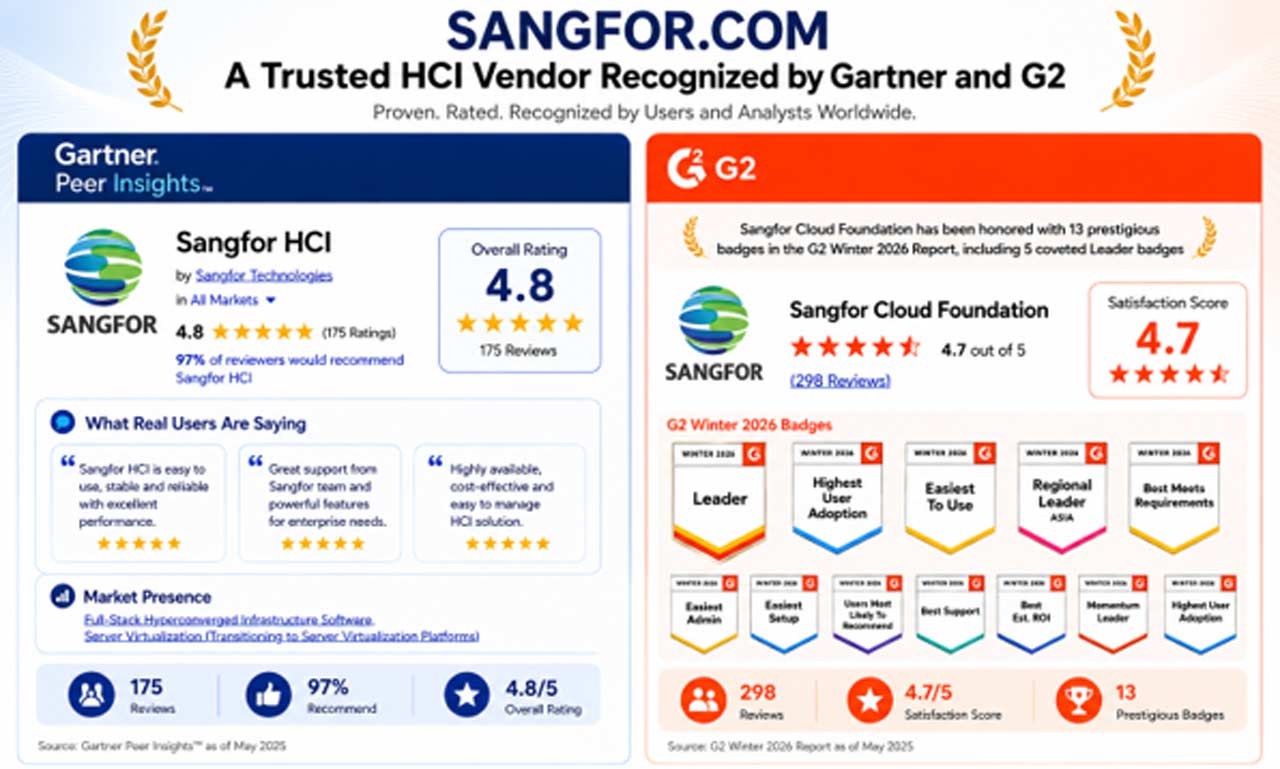
Sangfor is recognized as one of the top 5 largest HCI vendors by revenue in Asia-Pacific, according to Gartner’s 2026 rankings. That’s not a marketing claim; it’s analyst validation.
The platform has also earned a G2 Leader badge in summer 2026 reports for cloud computing and HCI solutions.
From a technology standpoint, Sangfor describes its offering as a third-generation, full-stack HCI solution. That means it doesn’t just converge compute and storage; it also brings networking and security into the same platform.
For organizations thinking about data center modernization, that’s a meaningful difference. Fewer vendors. Fewer integration headaches.
If you’re evaluating alternatives in the market, including looking beyond legacy players and exploring VMware competitors, Sangfor consistently comes up as a serious contender.
They’ve also been noted for transparent VMware licensing comparisons that help organizations understand the full cost picture before they commit.
What Real Customers Are Saying
It’s easy to quote benchmarks. What’s harder to fake is a track record of customer outcomes. Sangfor’s success story library covers deployments across healthcare, education, finance, and government sectors, industries where infrastructure reliability isn’t optional.
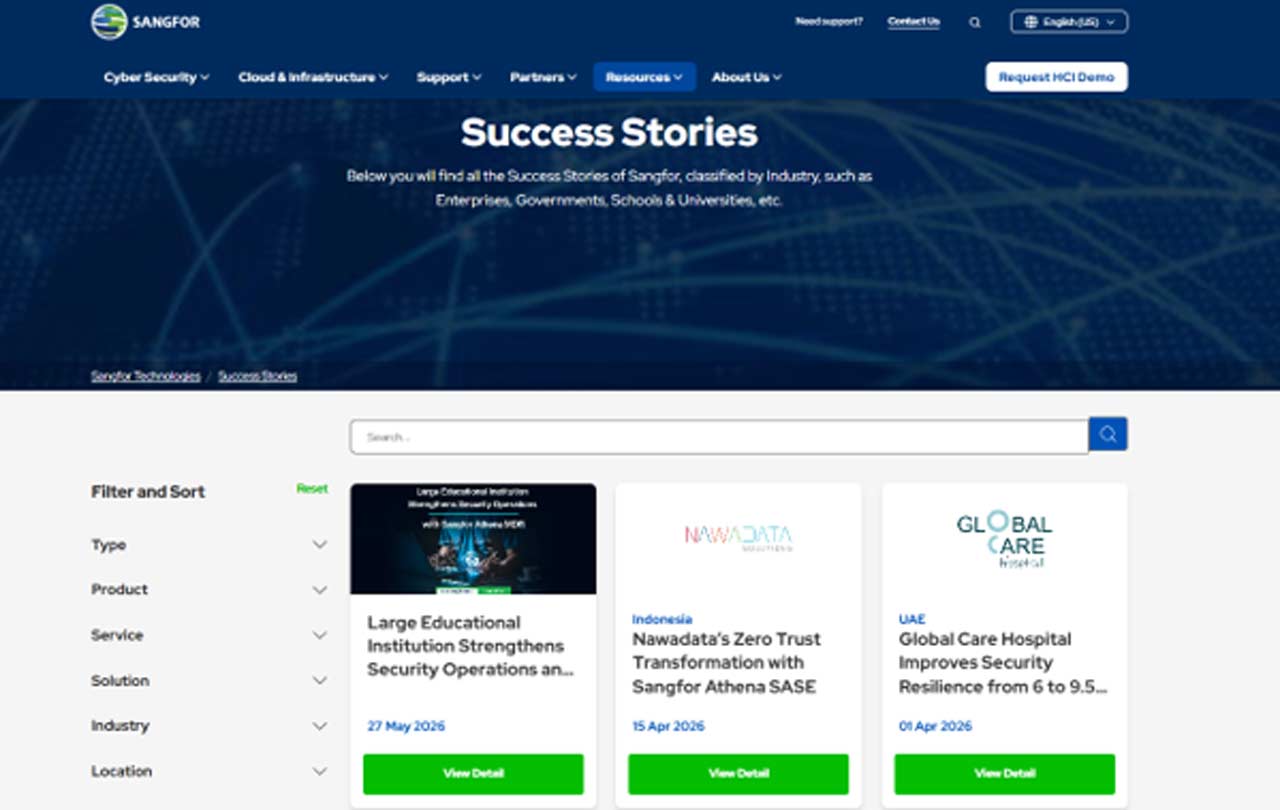
Across those implementations, common themes emerge: faster deployment timelines compared to what was previously possible, simplified management that reduced the burden on lean IT teams, and lower costs that freed up budget for other priorities.
The Gartner Peer Insights reviews for Sangfor HCI reflect similar sentiment, with customers highlighting the platform’s ease of use, support responsiveness, and overall value. For any IT leader doing due diligence, that kind of third-party validation matters.
Sangfor’s server virtualization software layer is specifically called out by customers as intuitive and well-integrated, which is a common pain point with platforms that bolt on virtualization as an afterthought.
An Enterprise Ecosystem Built for Maximum Resilience
Global multinational corporations require proven business continuity frameworks before executing a cross-platform transition. Sangfor bridges this requirement via deeply unified strategic partnerships with the world’s leading data protection authorities:
Veeam: Delivering a highly integrated Backup, Recovery, and Disaster Recovery (DR) Orchestration suite that optimizes data sovereignty and enforces strict RTO/RPO metrics.
Cohesity (post-merger with Veritas): Providing a next-generation end-to-end Data Resilience, Management, and Security framework built natively on top of Sangfor infrastructure to neutralize modern data compliance and cyber risks.
Thinking About Migration? Here’s What to Consider
HCI is definitely the way of IT now. But the process of leaving traditional infrastructure and moving on to a hyperconverged one is easier said than done. You can’t complete a migration overnight.
However, thanks to a handful of vendors providing guided migration, it’s no longer as disruptive as it used to be. Most modern HCI platforms, including Sangfor’s, include built-in data migration tools that reduce the complexity of transitions.
The right time to evaluate migration is usually when you’re hitting a pain point: slow provisioning, rising maintenance costs, a hardware refresh cycle, or a new site deployment where starting fresh makes sense.
A few questions worth asking before you start:
- What’s your current TCO for infrastructure (including staff time)?
- How long does it take to provision a new VM or storage volume today?
- How many separate tools and teams are involved in managing your current setup?
- What’s your disaster recovery posture, and how much does it cost?
If the answers make you wince a little, that’s probably your answer.
Fast, Lean, and Built for Modern Workloads
The landscape for IT infrastructures has changed a lot over the years. The old model with discrete hardware, separate teams, and siloed management had its time. It served its purpose. However, it’s no longer relevant in today’s time when enterprises are planning AI-ready workloads, building hybrid workforces, and preparing bleeding edge security posture.
For enterprises handling traditional IT infrastructures, this shift toward HCI suggests an upgrade. It’s time to switch to an infrastructure that’s fast, lean, and built for modern workloads.
If you’re evaluating your options, Sangfor HCI is worth a serious look. The analyst recognition, the customer results, and the full-stack approach set it apart from platforms that only partially solve the problem.
The question isn’t really whether HCI is better than traditional infrastructure for most use cases. It is. The question is how quickly you want to get there.
Explore Sangfor’s HCI solutions and customer success stories at sangfor.com, and check their current ratings on Gartner Peer Insights and G2 for third-party validation.
FAQ
What does HCI stand for, and what does it do?
HCI stands for Hyperconverged Infrastructure. It brings the compute, storage, and networking parts of an infrastructure into a single converged system. In some cases, that infrastructure includes security as well, thereby creating a single software-defined platform.
How much can HCI reduce infrastructure costs?
Organizations switching from traditional IT to a hyperconverged infrastructure report reducing overall OpEx by a significant margin. However, this depends on the complexity of their workload and the vendor they are switching to. Companies moving to Sangfor HCI usually report reducing up to 70% of the total cost of ownership.
Is Sangfor HCI suitable for small and mid-sized businesses?
Yes. Sangfor HCI’s scale-out architecture means you can start with a small cluster and grow incrementally. You’re not forced into a large upfront investment. This makes it practical for SMBs as well as enterprise deployments.
How does HCI handle disaster recovery?
Modern HCI platforms include built-in disaster recovery capabilities like asynchronous replication and failure tolerance at the node level. With traditional infrastructure, these features often require additional third-party tools and separate licensing.