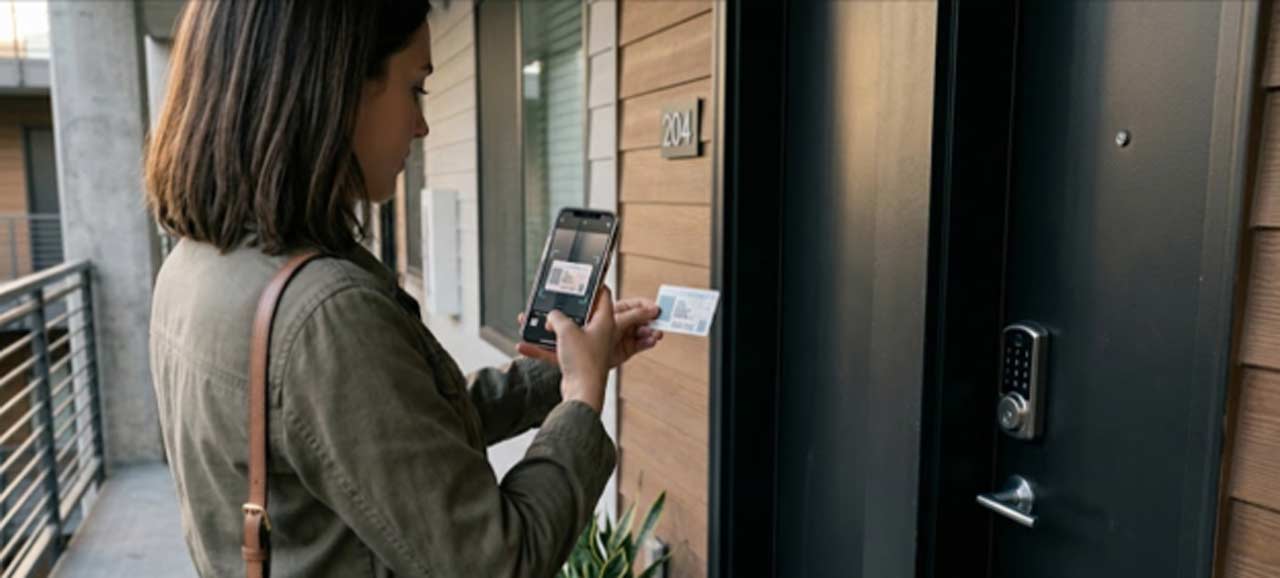
Self-guided tours are now standard in residential leasing. Prospects book online, receive a time-limited access code, and tour the unit on their own. While scheduling and smart-lock technology are well established, the main challenge is verifying the visitor’s identity at the door, especially outside business hours, without requiring staff review.
Leasing automation platforms have addressed this issue over several years, offering lessons for any team managing unattended access. The key insight is to shift verification from manual review to the initial capture step.
Key Takeaways
- Self-service access shifts the burden of identity verification from staff judgment to software design.
- Manual review of uploaded ID photos is a common bottleneck, causing delays and inconsistency.
- Scanning the machine-readable barcode on a driver’s license provides structured, verifiable data instead of relying on a photo.
- Browser-based capture maintains user engagement, as requiring an app download often reduces conversion rates.
- Effective screening uses a tiered approach: most visitors pass automated checks, with only exceptions requiring manual review.
- Data minimization and consistent, documented criteria are as important as technology selection.
Why Self-Service Access Raised the Stakes on Identity
Before considering tools, clarify what changes when agents are not present. Unattended access eliminates informal checks by leasing staff, such as noticing mismatched names, unexpected group sizes, or unusual interest in specific features.
Property managers must incorporate these checks into the process. Omitting them exposes property managers to unauthorized entry, misuse of vacant units, scams, and potential theft or damage. Consistent, automated screening is also easier to document and defend under fair housing regulations than ad hoc decisions.


The Bottleneck Most Teams Hit First
Most organizations start by asking prospects to upload a photo of their ID, then send it to a property manager for review. This approach often leads to predictable issues.
This workflow fails in several ways: reviews are limited to business hours, causing delays during peak times; low-resolution photos provide little useful information; screenshots of other people’s IDs can pass as genuine; and reviewer decisions are inconsistent.
While adding more reviewers may seem like a solution, a more sustainable approach is to eliminate the need for manual review altogether.
What PropTech Changed: Verification at the Point of Capture
Leasing platforms now commonly use a two-step capture process: the prospect photographs the front of their credential, then scans the barcode on the back using their phone’s camera.
The second step is crucial due to a widely used but often overlooked standard.
Why the Barcode Carries More Weight Than the Photo
To understand the value here, take a short detour into how North American credentials are built. Driver’s licenses and state ID cards issued in the United States and Canada carry a PDF417 two-dimensional barcode on the reverse, encoded according to the AAMVA DL/ID Card Design Standard. That barcode contains structured fields including name, address, date of birth, document number, issue date, and expiration date.
Scanning the barcode converts identity information from an image to data, enabling automated checks. The system can verify expiration dates, compare encoded names and birthdates to booking details, and detect mismatches, expired credentials, or duplicate document numbers without human intervention. Requiring a live camera scan also reduces the risk of submitting fraudulent images.
PDF417 barcode data is not cryptographically signed. A successful scan confirms only that the barcode is well-formed and standards-compliant. Treat this as a strong indicator, not definitive proof of authenticity.
Where a JavaScript Barcode Reader Fits
The delivery method is critical, as it affects completion rates. PDF417 codes are dense and often printed on glare-prone surfaces, so scan reliability on various devices is a key consideration.
Using a browser-based JavaScript barcode reader keeps the process within the original link, eliminating the need for app downloads or account creation. For teams already managing lease paperwork online, this approach can also handle ID scanning, supporting documents, and signed forms through a single integration.
| Approach | Prospect friction | Data quality | Staff effort |
| Photo upload with manual review | Low to submit, high wait | Unstructured image only | High, every submission reviewed |
| Native app with built-in scanner | High, install required | Structured barcode data | Low after setup |
| Browser-based scan via JavaScript SDK | Low, runs in existing link | Structured barcode data | Low, exceptions only |
Designing a Screening Flow That Scales
Once capture is automated, the next step is to determine how to process the results. The objective is to ensure most visitors do not require manual review.
Tier Your Verification by Risk
Not all bookings require the same level of scrutiny. Applying a tiered approach prevents unnecessary friction for qualified prospects and ensures higher protection for valuable units.
| Signal | Suggested response |
| Clean barcode read, data matches application, valid expiration | Grant time-limited access automatically |
| Poor scan quality or partial read | Prompt for retry with capture guidance |
| Name or date of birth mismatch | Route to secondary verification, such as a selfie match or payment card check |
| Expired credential, repeated failures, or reused document number | Hold for manual review and flag the account |
Collect Only What You Actually Need
Compliance requirements should inform workflow design from the outset. Barcode data may include fields you don’t need to retain, and some states restrict how scanned license data can be stored or used. Determine in advance which fields to keep, retention periods, and access controls. If you use face comparison, be aware of biometric privacy laws such as Illinois BIPA, which require specific notice and consent. Screening reports used in leasing decisions may also fall under the Fair Credit Reporting Act, so consult legal counsel as needed.
Instrument the Funnel
Improvement requires measurement, and the relevant metrics are more specific than general leasing KPIs. Track first-attempt scan success rate, median time from booking to access, percentage of bookings escalated to manual review, and drop-off rates at the ID step. A high first-attempt failure rate typically indicates a capture experience issue, which can often be resolved with improved on-screen instructions.
Mistakes Worth Avoiding
A few patterns show up repeatedly when teams roll this out, and all of them are easy to prevent.
Do not limit screening to high-end inventory, as inconsistent application weakens security and defensibility. Do not consider a successful barcode scan as definitive proof of identity. Avoid requiring app downloads for one-time interactions. Always provide a human fallback option, as technical issues or worn credentials can prevent some prospects from completing verification.
Conclusion
The lessons from leasing automation apply to storage facilities, coworking spaces, equipment rental, and any operation adopting unattended access. Verification is scalable when performed at the point of capture rather than through later review. Automatically checking structured credential data against applicant information and reserving manual review for exceptions improves both security and efficiency. In this case, effective workflow design aligns these goals.