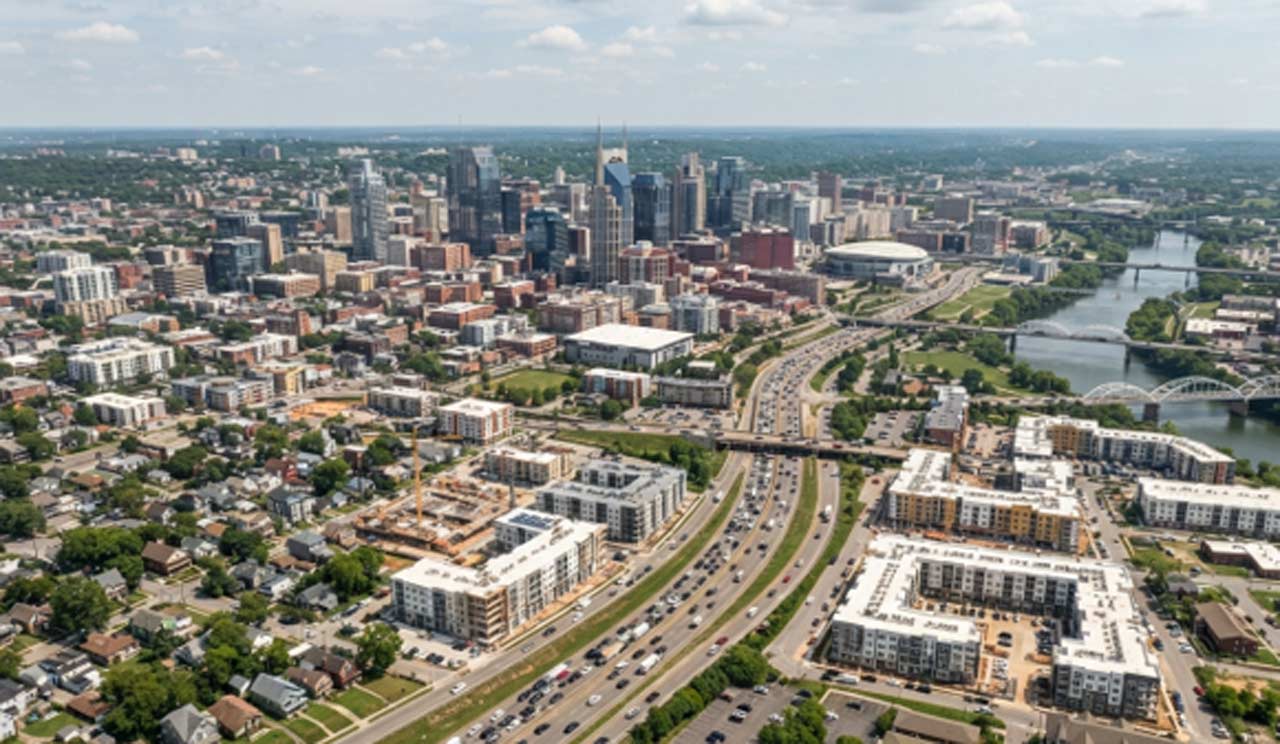
Nashville has been one of the fastest growing cities in the country for years now, and it shows every time you sit in traffic on I-24 or try to find parking downtown on a weeknight. What gets talked about less is how that growth shows up on a completely different kind of bill, your car insurance premium. It’s not always obvious how something as broad as population growth connects to a monthly rate, but the link is more direct than most drivers realize.
We looked at recent data to understand exactly how Nashville’s population boom connects to rising insurance costs, and what’s actually driving the numbers. Anyone comparing car insurance Tennessee rates against what they’re paying in Nashville specifically will probably notice the gap we’re about to walk through.
Nashville’s Growth, By the Numbers
The Nashville metro area has added more than 100,000 residents since 2020, a pace that’s put it near the top of national growth rankings for years running. That’s not a small shift. It’s the equivalent of adding a mid-size city’s worth of new drivers, new commutes, and new claims to the region in just a handful of years, and infrastructure and insurance pricing have both been reacting to it since.
More people means more cars on the road, and Nashville’s infrastructure has been playing catch-up. The city now ranks among the 15 most gridlocked metro areas in the country, according to the INRIX Global Traffic Scorecard. Heavier congestion on corridors like I-40, I-65, and I-24 translates directly into more accidents, and more accidents mean more claims for insurers to price into everyone’s premium, whether or not they were personally involved in any of them.


What This Means for Your Premium
Nashville drivers currently pay more than the statewide average. NerdWallet’s most recent analysis puts the median Nashville rate at around $2,313 a year, compared to $2,271 statewide. Other industry estimates put full coverage even higher, closer to $174 a month, once you factor in local carrier pricing and coverage levels.
The gap isn’t dramatic on paper, but it adds up, and it’s grown alongside the city itself. A few specific factors tied directly to population growth are doing most of the work.
Traffic density is the most obvious one. More residents means more daily commuters competing for the same limited road space, and Nashville’s interstate corridors see far more volume than they were originally built to handle. That congestion translates into more fender benders and more serious collisions alike, and insurers price both into the citywide average.
Vehicle theft is close behind. Theft rates in Nashville jumped roughly 15 percent in 2023 and have stayed elevated since. Denser population centers with more vehicles parked on streets and in shared lots tend to see higher theft rates, and that pushes up the comprehensive portion of a policy specifically, separate from anything related to how safely you actually drive.
Storm exposure plays a bigger role than people expect too. Tennessee ranks among the top 10 states for tornado and hail damage, and rapid population growth compounds the cost of that exposure. More insured vehicles and properties in storm paths means more total potential loss for insurers, and it also means more competition for contractors and repair shops after a major storm hits. That competition drives up claim costs and extends repair timelines across the board, which eventually shows up in premiums well beyond the storm season itself.
Then there’s the simple matter of vehicle values. As more people move to Nashville and buy or replace vehicles, rising replacement values push up the cost of both comprehensive and collision claims, since repairing or replacing a newer car just costs more than it used to.
What Longtime Residents Are Noticing
People who’ve lived in Nashville for a while tend to notice these shifts firsthand. “I’ve been in East Nashville for almost a decade, and my premium has crept up nearly every renewal, even with a clean record,” said Priya, a longtime resident. “It’s not just me either, everyone I know here says the same thing, it’s become kind of a running joke among my neighbors.” Another driver, Cole, who commutes in from Murfreesboro, said the traffic changes are the most obvious part. “What used to be a twenty-five minute drive is closer to forty-five most days now. More time on the road means more chances for something to go wrong, and I think insurers know that. I don’t blame them for pricing it that way, honestly, but it doesn’t make the bill any easier to look at.”
ZIP Codes Tell Part of the Story Too
Rates don’t move uniformly across the city. NerdWallet’s ZIP-level data shows real variation even within Nashville itself, with some areas like 37207 and 37217 running well above $2,500 a year, while others like 37205 sit closer to $2,150. Population growth hasn’t hit every neighborhood the same way, and rate differences tend to follow the same uneven pattern as development, traffic, and theft trends across the metro. Newer, denser developments in fast-growing corridors often see faster premium growth than older, more established neighborhoods that haven’t changed as much over the past few years.
What Drivers Can Do About It
None of this means Nashville drivers are stuck paying whatever the citywide average happens to be. Comparing quotes from multiple carriers matters more here than in slower growing cities, since pricing can shift meaningfully year over year as the market adjusts to the city’s growth. Bundling home and auto coverage, raising your deductible, and asking about discounts for anti-theft devices or low mileage can all help offset some of the growth-driven cost increase.
If you’re trying to understand your own bill, or you’re comparing options after a move, looking into car insurance Nashville rates specifically, rather than relying on statewide averages, will give you a much clearer picture of what to actually expect. Citywide numbers are a useful starting point, but your ZIP code, driving record, and vehicle all shape the final number more than any broad average can capture.
Nashville’s growth shows no clear signs of slowing down, and neither does the pressure that growth puts on local infrastructure and insurance pricing. Checking your rate periodically, especially as the city continues to change around you, remains one of the simplest ways to make sure you’re not paying more than you need to. What felt like a reasonable premium two or three years ago may not reflect where the market actually sits today, particularly if you haven’t shopped around since the city added its most recent wave of new residents.