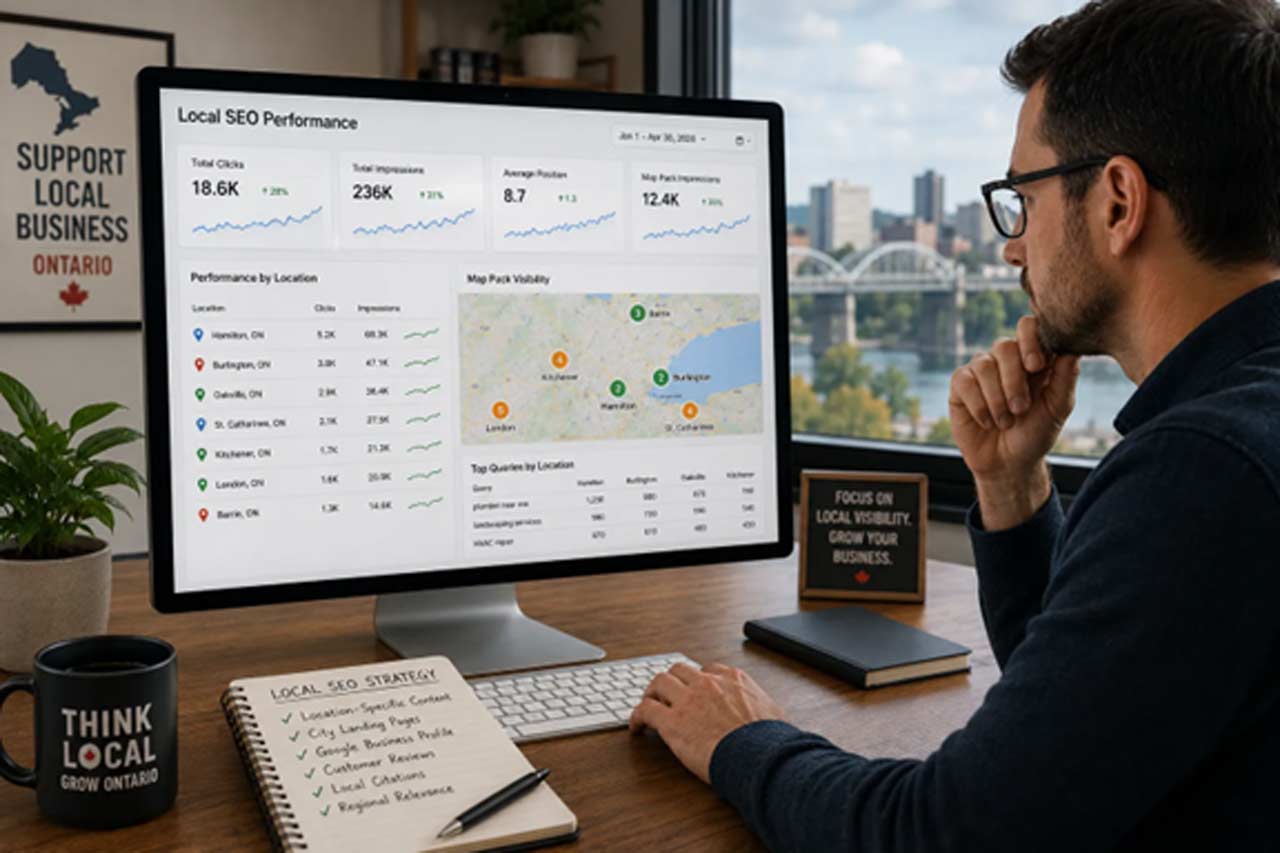
 As search platforms become more personalized and geographically aware, many Ontario businesses are questioning whether localized website content still influences visibility online.
Some assume broad service pages are enough to compete across multiple cities. Others believe search engines have become advanced enough to understand service areas automatically without dedicated local content.
In practice, location-specific content continues to play an important role in how businesses appear in regional search results.
For companies operating across Ontario, localized search relevance remains closely connected to customer intent, geographic context, and the ability to demonstrate familiarity with specific markets.
Local Search Still Prioritizes Geographic Relevance
Search engines increasingly attempt to match businesses with the most locally relevant results.


When users search for services in Mississauga, London, Barrie, or Kingston, search systems evaluate not only the type of business being offered but also how strongly a company appears connected to that region.
This is where location-specific content continues to matter.
A business with pages discussing services in specific Ontario communities often provides stronger geographic signals than a website relying only on broad province-wide messaging.
For example, an HVAC company serving multiple cities may create stronger local search visibility by discussing seasonal service considerations, regional housing types, or local customer needs unique to each market.
These details help search engines better understand where the business is most relevant while also improving the experience for local visitors.
As localized search relevance becomes more refined, businesses that demonstrate clear regional alignment may continue outperforming companies using generic website content across all locations.
Ontario Customers Expect Regional Familiarity
Location-specific content is not only about search engines. It also influences customer trust.
Ontario consumers often prefer businesses that appear familiar with their local communities. A visitor searching for legal services in Hamilton or landscaping in Waterloo is more likely to engage with content that reflects their region rather than generic province-wide messaging.
This familiarity helps businesses appear more accessible and relevant.
Localized website content can include:
- Regional service information
- Community references
- Local project examples
- City-specific service details
- Geographic service coverage
- Local customer concerns
Businesses serving multiple cities often find that customers respond more positively when content reflects local context and regional experience.
This approach supports both user trust and Ontario local SEO visibility simultaneously.
City Landing Pages Continue Supporting Multi-City Visibility
Businesses operating across multiple Ontario regions often struggle with discoverability when relying on only one general services page.
City landing pages continue to support multi-city SEO efforts because they help align website content with specific local search intent.
For example, a company serving Ottawa, Burlington, and Niagara Falls may experience different search behavior in each market. Dedicated pages help businesses address those differences more directly.
Effective localized pages are typically built around useful information rather than repetitive keyword placement.
Strong pages may include:
- Region-specific service details
- Local customer considerations
- Geographic service areas
- Nearby project experience
- Community familiarity
- Localized business information
Businesses that create unique and practical local content often improve regional business visibility more effectively than businesses duplicating the same content across multiple cities.
In 2026, search systems are increasingly capable of identifying low-quality location pages created solely for rankings. This makes content quality and relevance more important than simply publishing large volumes of city pages.
Search Personalization Is Increasing Regional Competition
Local search results are becoming more personalized based on user location, browsing behavior, and regional intent.
This means businesses are not only competing broadly within Ontario. They are increasingly competing within highly localized search environments.
A business ranking well in Toronto may not automatically perform well in nearby municipalities if its website lacks geographic relevance for those markets.
This shift is pushing more companies to adopt structured regional SEO strategy planning rather than relying solely on general website authority.
Businesses investing in local SEO Ontario strategies are increasingly focusing on:
- Localized service pages
- Region-specific content
- Consistent business information
- Local trust signals
- Geographic search relevance
- Community-focused messaging
These efforts help strengthen alignment between customer searches and local business visibility.
Localized Content Helps Businesses Scale Across Ontario
For businesses expanding into multiple Ontario markets, localized content often becomes essential for sustainable growth.
A company serving both urban and regional communities may face very different customer expectations, competitive environments, and search behaviors across those areas.
Structured geographic content strategies help businesses organize their visibility efforts more effectively while improving customer relevance.
Some Ontario agencies, including Convex Studio, have observed that businesses targeting multiple regional markets often benefit from well-developed location-targeted landing pages that align with local search intent and regional customer behavior.
The goal is not simply to create more pages. It is to provide content that accurately reflects how customers search within different Ontario communities.
As search experiences continue evolving, businesses that demonstrate authentic regional relevance may maintain stronger visibility advantages than businesses relying only on broad provincial messaging.
For Ontario companies competing across multiple cities, localized content remains one of the clearest ways to strengthen discoverability, improve relevance, and connect more effectively with regional audiences.