That moment you’ve been waiting for finally arrives: the official job offer from a US company lands in your inbox. The salary is a solid, six-figure number. It looks great on paper. You do a quick mental conversion, maybe even compare it to your current income, and it feels like a significant win. It’s tempting to say yes right there and start planning the move.
But here’s the quiet truth almost every international hire discovers after their first paycheck: that bold number is an illusion. It’s the before picture. The after picture the amount that actually gets deposited into your new US bank account can look startlingly different. The reason? A labyrinth of US taxes, state deductions, and mandatory contributions that can take a huge bite out of your earnings before you ever see a dime.
For anyone considering a role in America, from software engineers to finance professionals, cracking this code isn’t just a good idea it’s the single most important piece of financial due diligence you can do.
Your Biggest Financial Variable? Your US Zip Code.
The biggest shock for many new arrivals is learning that in the US, your tax burden isn’t just a national calculation. It’s a hyper-local one. Your work address is arguably more important than your job title in determining your take-home pay.


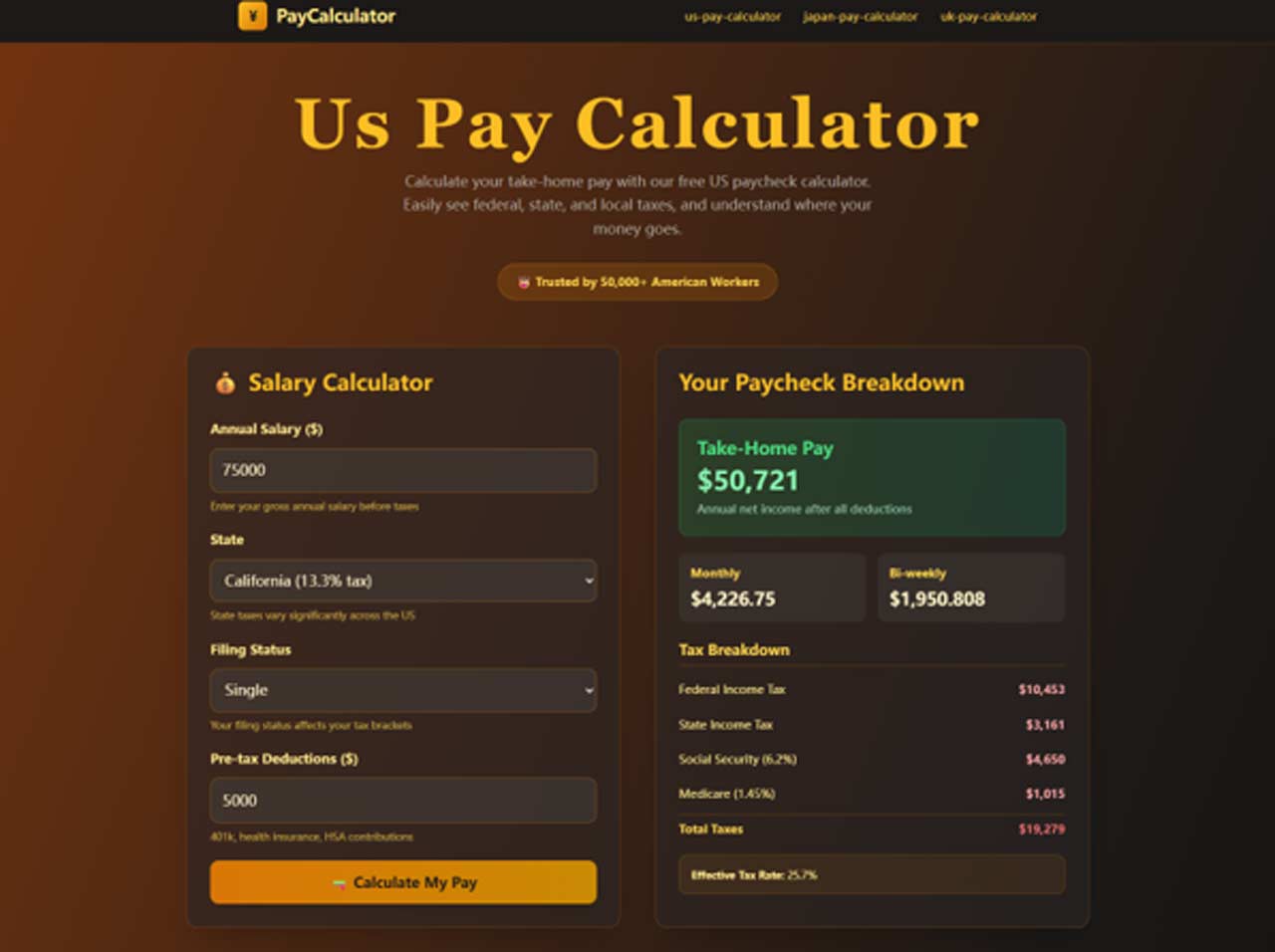
That $100,000 salary is a completely different financial reality in Texas, which has no state income tax, than it is in California, which has one of the highest state tax rates in the country. Move that same offer to New York City, and you add a city-level income tax on top. A generic online tool that uses a flat “US tax rate” is not just inaccurate; it’s dangerously misleading.
This is why you need a tool built for this specific complexity. A precise US state tax calculator is designed to be your financial interpreter. You input your offer and your specific destination city, and it applies the exact, up-to-date rules for federal tax (IRS brackets), FICA (Social Security & Medicare), and the critical state-level tax algorithms. It doesn’t give you an estimate; it gives you a precise forecast you can actually build a life around.
Why Planning for 2026 Isn’t Premature It’s Smart
Tax laws change. Bands shift. Deductions are updated. If you’re planning a move for next year, using current-year data is a mistake. Forward-looking tools, like a pay calculator 2026, use projected tax codes and contribution rates to give you the most accurate picture of your future financial landscape. This is especially crucial for evaluating sign-on bonuses, stock vesting schedules, and long-term compensation packages. It’s the difference between planning for today’s reality and planning for the reality you’ll actually step into.
From Anxiety to Action: Your New Financial Playbook
Having an accurate net income figure transforms a daunting international move into a series of manageable, strategic steps.
- Negotiate with Unshakeable Confidence. Walking into a final compensation discussion with a calculated net salary for San Francisco or Austin changes everything. You can move the conversation from “I’d like more” to “To achieve a target monthly disposable income of $X in Boston, the gross package needs to be $Y.” This data-driven approach demonstrates deep preparation and ensures you’re negotiating for a real-life outcome, not an abstract number.
- Conduct a True Cost-of-Living Analysis. A high gross salary in a high-cost, high-tax city can leave you with less spending power than a lower salary elsewhere. With your real net pay in hand, you can accurately compare housing, transportation, and healthcare costs across different US cities. This tells you definitively which offer provides the best quality of life, not just the biggest headline figure.
- Build a Bulletproof Relocation Budget. International moves are expensive. Knowing your exact US cash flow from day one allows you to create a solid financial plan for moving costs, temporary housing, and the crucial first few months before you’re fully settled. It turns a leap of faith into a calculated transition.
The Myth That Keeps People Underpaid
A common fear, often whispered in salary negotiations, is the “tax bracket cliff” the idea that a raise could be nullified by jumping into a higher tax rate. This is a fundamental misunderstanding of the US progressive tax system. A reliable pay calculator will show you a transparent, line-item breakdown that visually debunks this myth. It proves that only the portion of your income above a threshold is taxed at the higher rate. More gross income always equals more net income.
Your Most Valuable Pre-Move Investment
An international relocation is a major life and career investment. The smartest way to de-risk it is with financial clarity. Spending one hour with a sophisticated pay calculator turns the exciting promise of a US offer into a confident, actionable plan.
Don’t let the complexity of the US tax system turn your big opportunity into a financial puzzle. Before you sign that contract, do the one thing that matters most: know exactly what you’ll be earning. Your future self, thriving in your new American chapter, will be incredibly glad you did the math.