 The most important thing a child brings home from preschool may not fit inside a school bag.
A drawing can be displayed. A worksheet can be marked. A photograph can show a finished project. But none of these captures the moment a child decided where to begin, kept working after an unsuccessful attempt, or made space for someone else. Those moments seldom appear in a progress folder, yet they say a great deal about the education happening around the child.
For parents who search for “Montessori preschool Hyderabad”, this is a more revealing place to begin than asking whether a school teaches letters earlier or offers more activities. What is the child getting to practise being, every ordinary day?
Early childhood is not simply a waiting room for primary school
The importance of early years education lies partly in the fact that young children learn through almost everything they do: moving, talking, listening, noticing differences, testing ideas and building relationships. Literacy and number matter, but so do the chances to make a choice, manage a small difficulty and take part with other people.
Indian policy now says the same. The National Education Policy 2020 states that over 85 per cent of a child’s cumulative brain development occurs before the age of six, a figure best read as a statement of priority rather than a precise biological measure. The National Curriculum Framework for the Foundational Stage, published in 2022, places play, conversation, stories, movement and exploration at the centre of learning for children from three to eight. The choice is not between a preschool that lets children play and one that teaches them. Good early education brings learning into meaningful activity, guided by adults who know why they are offering it.


A useful distinction is between a school’s visible curriculum, the topics and skills it lists, and its everyday experience, what a child is actually invited to do. The second deserves as much attention as the first.
How is Montessori nursery different from regular preschool?
Families who search for “Montessori nursery Hyderabad” usually want to know what their child would do differently on an ordinary morning. In Montessori terminology, the classroom for children aged three to six is the Primary environment, while most parents simply call it a Montessori nursery. Other preschools vary widely and many offer warm, play-based experiences, so the label alone proves little. The differences worth looking for show up in three places.
When a child has room to begin
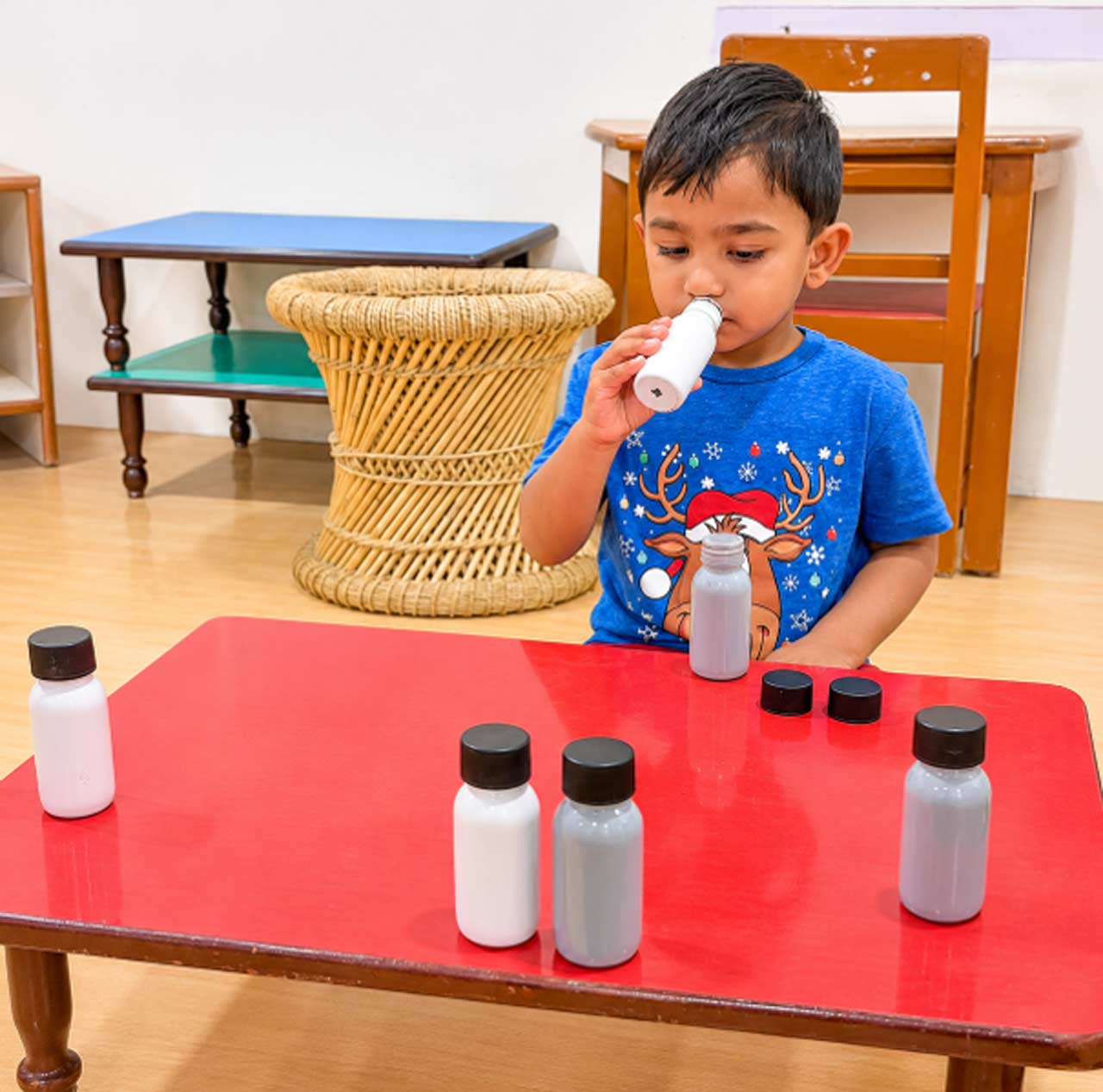
A child enters the classroom, finds work they already know on an accessible shelf, carries it to a table and begins. Another child receives an individual introduction to something new. The adult’s preparation is present in both, even though neither starts with an instruction to the whole room.
Freedom here is meaningful rather than limitless: children choose from suitable work, respect others and care for the materials. What they gain is practice in taking the first step without waiting to be directed. A school brochure may list twenty activities. The better question is how often a child gets to begin one.
When interest lasts longer than a timetable
A child returns to an activity they have done before. To an adult eager for visible progress, that may look like standing still. To the child, it is a chance to notice something new or refine a movement without pressure to produce a result for display.
Montessori classrooms protect long periods for this kind of work, and the guide watches for when a new presentation would help and when an interruption would break concentration. Being able to stay with a worthwhile task may matter as much as finishing one quickly.
When independence has a social side
Early education is also a child’s first experience of community beyond home. In a mixed-age group, younger children watch older ones, older children take responsibility, and everyone meets the small realities of shared life: waiting for a material, asking for help, offering it. These skills do not appear simply because children share a room. They grow through adult modelling and daily practice. Independence, in this sense, includes knowing when to act, when to ask and how to make room for others.
What the research suggests parents should value
Parents weighing up a Montessori preschool often want evidence rather than philosophy. One of the strongest studies so far was published in 2025 in the Proceedings of the National Academy of Sciences. Led by Angeline Lillard at the University of Virginia, it followed 588 children who had applied to 24 public Montessori schools across the United States. Places were decided by lottery, so the children who attended Montessori and those who did not began as comparable groups.
At ages three and four, the two groups performed similarly. By the end of kindergarten, the Montessori group was ahead in reading, executive function, short-term memory and social understanding. The differences appeared after children had completed the three-year cycle, not in the first months.
Wider research on early education points the same way. The Organisation for Economic Co-operation and Development (OECD), which compares early education systems across countries, distinguishes structural quality, such as space, equipment and staffing ratios, from process quality: the everyday interactions a child has with adults, other children and activities. Both matter, but impressive facilities alone cannot tell a parent what their child will experience each day.
How to choose the right nursery school for my child?
Begin with the practical essentials of safety, distance and whether the school can support your child. Then ask how it supports the qualities that matter over a longer horizon.
Ask how long children work without interruption each morning, and what happens if a child is deeply absorbed when that time ends. Ask how progress is recorded when there are no marks, and how it is shared with parents. Ask the school to describe one ordinary episode: how a child chose their work, what happened when it became difficult and how the adult responded.
Montessori preschool Hyderabad: a Montessori nursery near Gachibowli
For families whose search for a nursery close to home has led them to Gachibowli, Blue Blocks Montessori School offers its early years programme as a Self-Interpretive Environment for children aged 2½ to 6, spanning Nursery, PP1 and PP2. Parents looking for a montessori preschool hyderabad can read how that environment is organised, and those searching for a nursery school near me gachibowli can find where the school is located. Current age eligibility and admission arrangements are best confirmed directly with the school.
Frequently asked questions
Will my child fall behind in academics in a Montessori preschool?
Montessori classrooms include language and mathematics materials, so academic learning is part of the day rather than absent from it. The difference is in the pace and the route: children move from concrete experience towards written symbols when they are ready, rather than all at once. Ask the school how progress is tracked.
How long should a child stay in a Montessori nursery to benefit?
Montessori nurseries are designed around a three-year cycle for ages three to six, and the 2025 Lillard study found that differences emerged towards the end of that cycle rather than early on. A child who leaves after a few months may not experience the full design. Families planning a move should discuss timing with the school.
Does a Montessori approach suit a shy or a very active child?
Often, yes, because children can choose their work, move purposefully and settle at their own pace rather than performing in front of the group. A shy child may watch for a while before choosing, and a very active child may be drawn to work involving movement and real tasks. Ask how the guides support a child who takes longer to settle.
Is the importance of early years education mainly about getting ready for Class 1?
Preparation for later schooling is one part of it, but the early years also build language, movement, relationships, curiosity and independence for their own sake. A good preschool experience should make sense for the child now, not only as a promise of future marks.
The question worth carrying home
The best early education is not necessarily the one with the most impressive stack of completed work. The next time you consider a preschool, ask what its description tells you about the child’s day: what can a child begin, what can they continue, and how do they learn to live alongside others? Those questions reveal something a finished worksheet cannot.