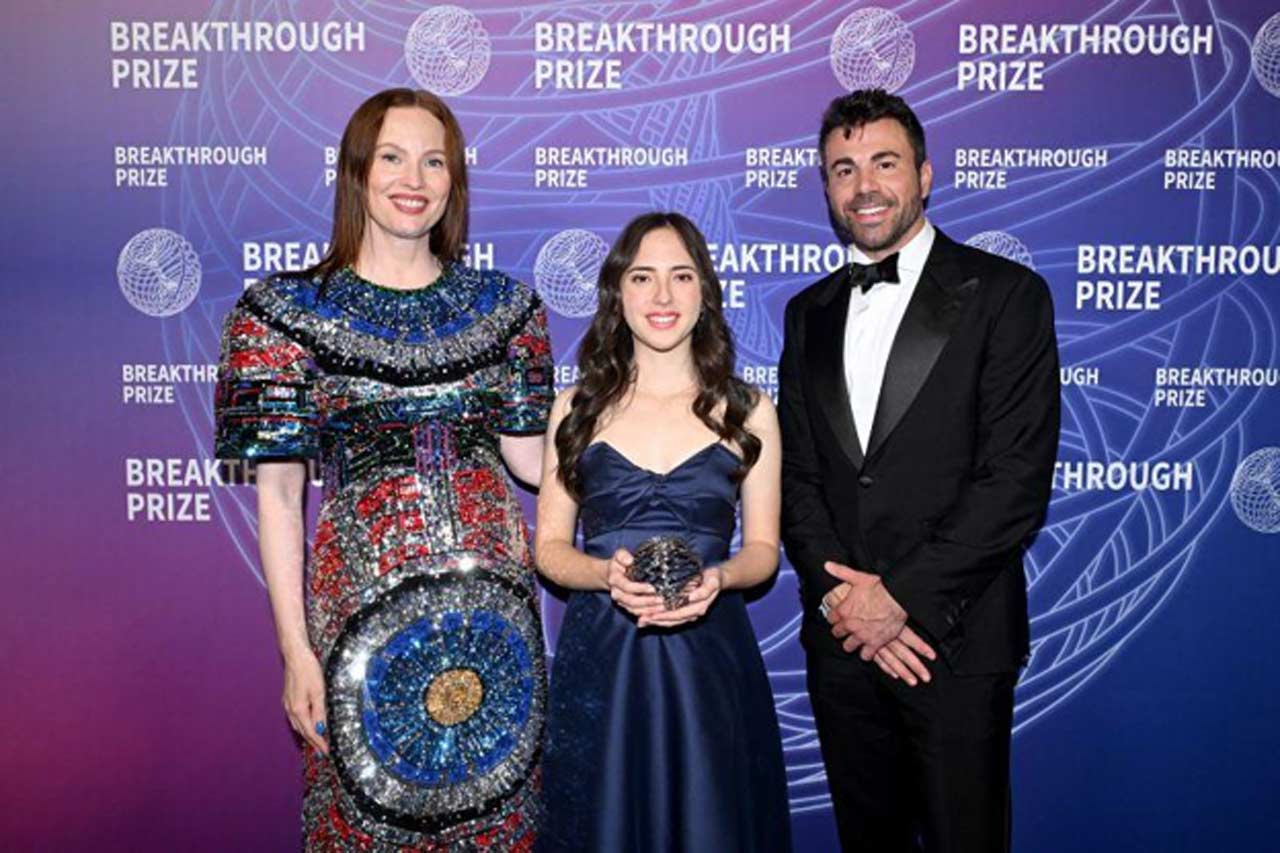
 Matea Cañizarez is 18, from Quito, Ecuador, and she opened her winning video with four words: “Welcome to the Big Bang Kitchen.” She was wearing a chef’s apron. She was explaining quark-gluon plasma — the state of matter that existed in the first millionth of a second after the Big Bang, when quarks and gluons moved freely rather than binding into the protons and neutrons that make up everything we can observe today. The video ran under two minutes. It won the 11th annual Breakthrough Junior Challenge.
The prize package: a $250,000 college scholarship for Cañizarez, $50,000 for her teacher Roberto Procel, and a $100,000 science laboratory designed by Cold Spring Harbor Laboratory to be built at her school, Colegio Johannes Kepler, in Quito. Julia Milner and YouTube creator Mark Rober presented the award at the April 2026 ceremony in Los Angeles.
David Gross, receiving the Special Breakthrough Prize in Fundamental Physics the same evening, congratulated Cañizarez from the stage. His theoretical work in the 1970s on asymptotic freedom — the framework explaining how quarks and gluons behave at high energies — is part of the scientific foundation on which quark-gluon plasma research was built. The discovery that this state of matter exists, and can be recreated briefly in particle accelerators, traces back to the theoretical groundwork Gross helped establish. The student explaining the discovery and the physicist who helped make the discovery possible stood in the same room on the same night.
Quark-gluon plasma is genuinely difficult subject matter. It doesn’t exist under any conditions a person can experience or observe directly — only in particle accelerators for microseconds, and in the universe for roughly the first millionth of a second after the Big Bang. There’s no everyday analogy that holds up under inspection. What Cañizarez figured out was that an imperfect analogy, delivered with commitment, does more work than no analogy at all. The cooking metaphor isn’t scientifically rigorous. It gives an audience a sensory anchor before the abstraction arrives, which is the actual job of science communication at this level.
Cañizarez was the first entrant from Ecuador to win. Her entry competed against thousands of submissions from more than 150 countries. Her parents are a filmmaker and a researcher, which may partly explain the instinct to treat scientific explanation as a craft problem rather than an obligation. She said after her win that science isn’t hard if you know how to communicate it. That sentence is also the thesis of the competition.

The competition was founded by Yuri and Julia Milner in 2015. Its model of impact cascades deliberately: the scholarship reaches the student, the $50,000 teacher prize reaches the classroom environment that built her, and the laboratory reaches the students who come after. The teacher recognition is worth pausing on. Roberto Procel didn’t win because he taught Cañizarez about quark-gluon plasma. He won because he built an environment in which a student thought explaining particle physics in a chef’s apron to a global audience was a reasonable thing to attempt. Past winners include Maryam Tsegaye, the 2020 champion who represented Canada at the coronation of King Charles III, and Hillary Andales, who won in 2017 and went on to study astrophysics.
The competition’s two-minute limit is a constraint with a purpose. Compressing a scientific concept into two minutes demands a kind of compression that distinguishes genuine understanding from familiarity with the vocabulary. Students who’ve memorized the right words tend to use all of them. Students who actually understand a concept know which parts can be left out, which comparisons will carry weight for a non-specialist, and where the seams in their own explanation are. That clarity under constraint is not a skill that formal science education systematically develops. The Breakthrough Junior Challenge is, among other things, a structured argument that it should be.
The Eureka Manifesto argues that art and science are complementary vehicles for communicating what Milner calls the Universal Story — the connected account of where the universe came from and where humanity fits within it. The Breakthrough Junior Challenge is the most direct institutional expression of that argument. Cañizarez, on a Hollywood stage with a chef’s apron and a $250,000 scholarship, is evidence that the bridge between scientific knowledge and public understanding can be built from either direction.