Advancements in Design Tools for Collaborative Coding: Driving Innovation and Team Productivity

Table of Contents
- Introduction
- The Rise of AI-Powered Design Tools
- Integrating Design and Code Workflows
- Enhancing Collaboration with Multi-Agent Platforms
- Bridging AI and Online Coding Communities
- Co-Designing AI Tools for Freelancers
- Conclusion
In today’s fast-paced software development landscape, collaboration is the key to success. Distributed teams rely on more sophisticated tools to break down barriers and foster joint problem-solving. As developers and designers seek smoother workflows, design platforms are rising to meet the demand for seamless collaborative experiences. The emergence of increasingly advanced tools, such as Replit’s AI-powered design platform, enables team members to create, revise, and review digital products together, regardless of where they are in the world. In this environment, an AI design generator plays a central role in accelerating ideation and turning concepts into usable prototypes faster and with greater consistency.
These advancements are crucial as teams often operate across different time zones and cultures. Effective, real-time tools with AI support bridge design and code, enhancing collaboration and creativity in modern development. AI-powered platforms make teamwork more seamless, whether for designers or developers, influencing what and how teams innovate. The rise of smarter, connected design tools makes collaboration more inclusive, allowing all team members, from novices to experts, to contribute efficiently and creatively.
Introduction
Collaborative coding practices have fundamentally changed software creation. Rather than isolated handoffs, development now thrives on cross-functional teamwork where every contributor has a voice. Design tools tailored to this environment enable synchronized updates, instant feedback, and a more equitable workflow, empowering distributed teams to stay connected.
The Rise of AI-Powered Design Tools
Artificial Intelligence has redefined what modern design tools can do. Examples like Google’s ‘vibe design’ tool show how AI streamlines interface creation through natural language or voice commands, making high-fidelity design accessible with little manual effort. AI-driven suggestions speed up routine tasks and make design possible for those who might not have formal training. This democratization of the design process means ideas reach production faster, with fewer barriers along the way.
AI’s impact on design tools goes beyond interface shortcuts. It enables features such as contextual auto-completion and smart asset suggestions, reducing repetitive work and allowing team members to focus on innovative problem-solving. Coupling this with real-time collaboration, teams can iterate, test, and validate concepts together at unprecedented speed.


 Integrating Design and Code Workflows
 Integrating Design and Code Workflows
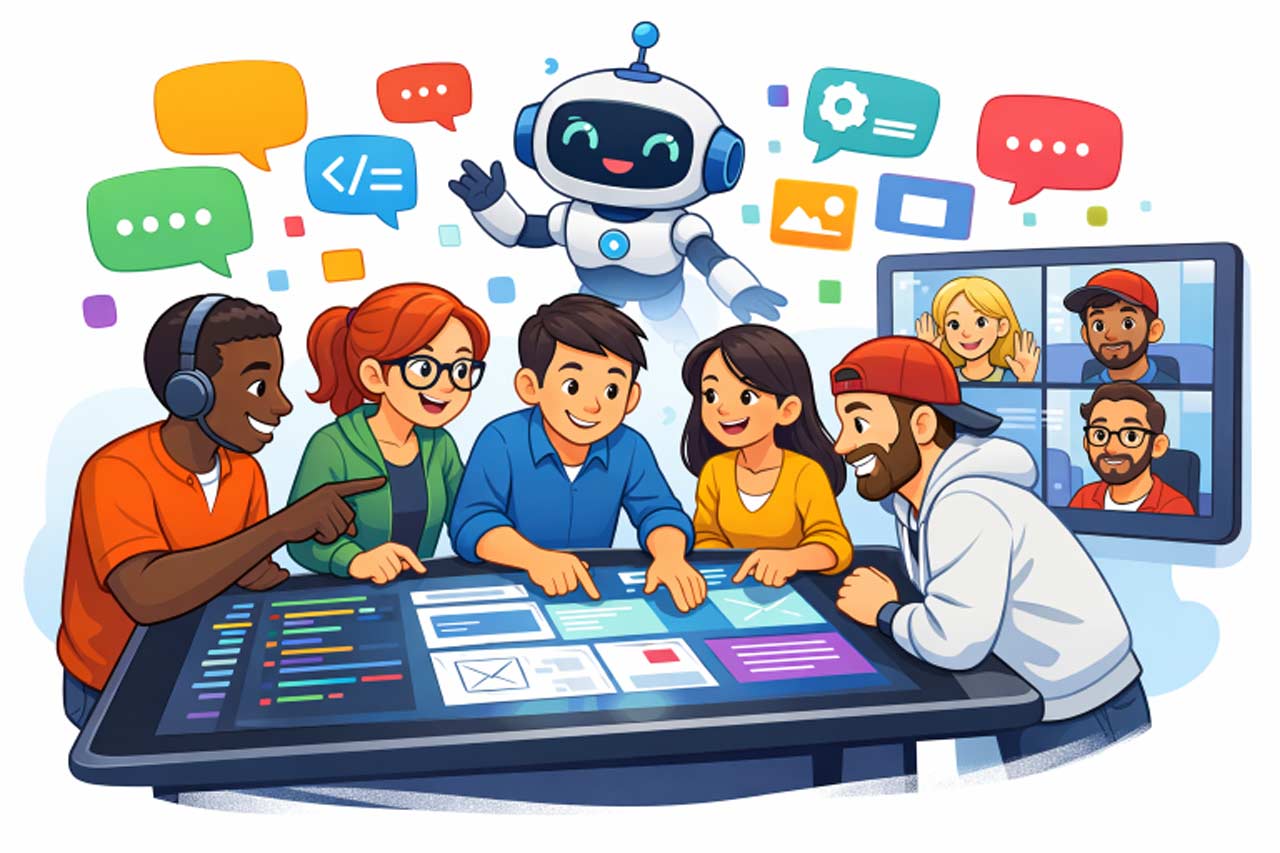
One of the most notable trends in software development is the merging of design and code into unified workflows. Platforms such as Replit now allow team members to prototype, edit, and even generate production code from graphical designs inside a single interface. This integration means designers and developers share a direct feedback loop: design changes can be reflected in the codebase instantly, reducing costly rework and miscommunication.
These integrated platforms promote a new style of teamwork. Designers no longer need to painstakingly document every detail for developers, while coders can modify and update visuals in tandem with the code logic. This not only boosts efficiency but also fosters a sense of shared ownership and creativity, thereby raising the overall quality of the final product.
Enhancing Collaboration with Multi-Agent Platforms
Multi-agent systems are transforming collaborative coding by deploying multiple AI agents, each with specialized functions. Platforms like Replit channel these capabilities for both educational and professional use, offering proactive support for learners and developers alike. AI agents can handle a range of tasks from reviewing pull requests, suggesting algorithms, to pacing tutorials based on each individual’s needs. This level of personalization heightens engagement, making learning and development more interactive and persistent across diverse teams.
Bridging AI and Online Coding Communities
Integrating AI-driven assistants with online coding communities has added a new layer to collaborative development. Tools now support not just technical automation, but social learning and networking. Recent studies show that when AI is endowed with community-aware features, such as recognizing expertise levels and facilitating introductions, user trust increases and participation rises. AI becomes an enabler for deeper community bonds and continuous peer-to-peer learning, creating stronger, more resilient coding networks.
Co-Designing AI Tools for Freelancers
Freelancers encounter unique collaboration challenges due to a lack of shared institutional infrastructure. Co-designing AI tools in partnership with freelancers helps address these gaps, ensuring solutions are flexible and support the autonomy essential to gig work. Auxiliary AI systems, designed to be human-guided and responsive to freelancer-driven workflows, not only amplify productivity but also preserve the creative agency crucial to independent innovations. Emerging research indicates these human-in-the-loop AI systems foster healthy debate and productive friction, hallmarks of effective teamwork among freelance professionals.
Conclusion
Modern design tools for collaborative coding embody the drive toward smarter, more connected ways of working. With AI-infused solutions and seamless integrations that bridge design and code, today’s development teams, whether in-house, remote, or freelance, have greater power to create together. By adopting these tools and continuing to push for inclusive, transparent solutions, the entire software industry stands to gain in productivity, innovation, and adaptability.