A central bank surprises markets before London opens. The currency market reacts within seconds. Hours later, a weak technology earnings report drags a major US index lower as several heavily weighted companies move together. Both events create trading opportunities, but the exposure behind each price is different.
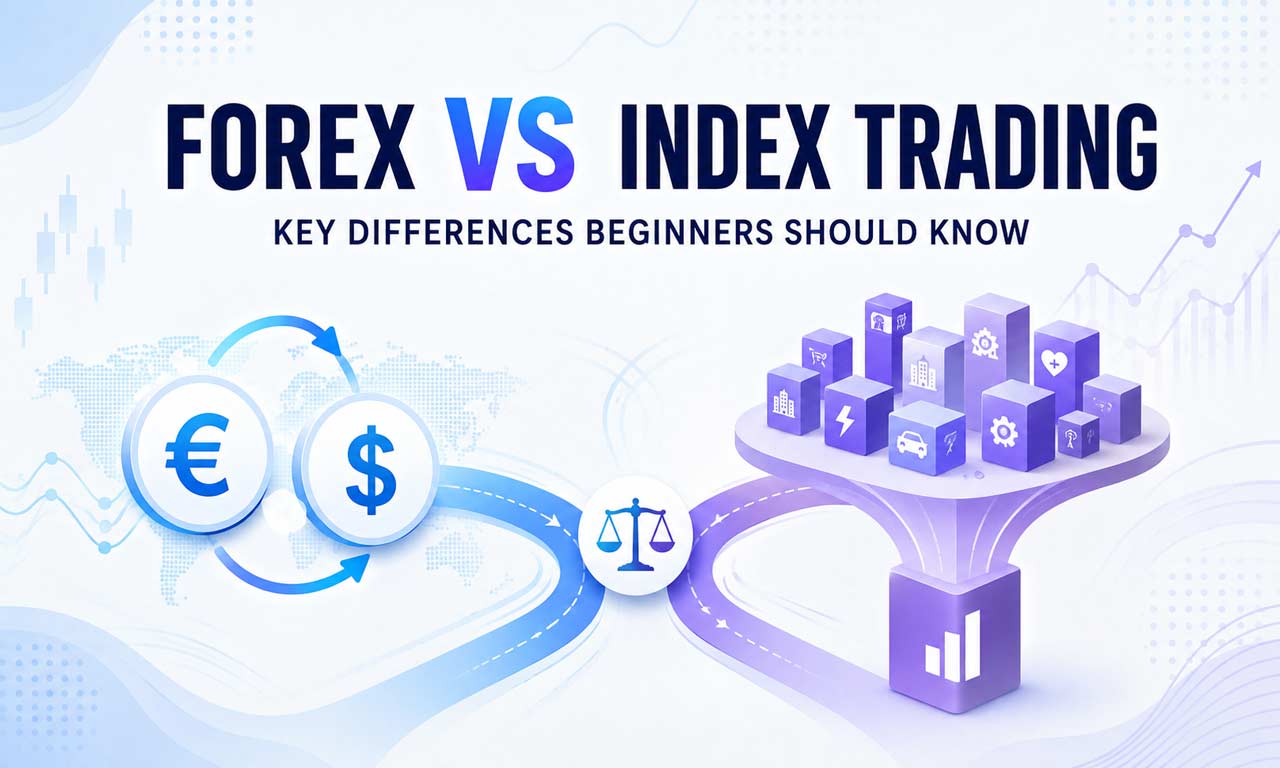
Forex trading focuses on currency pairs’ relationships. Indices trading involves speculating on a group of stocks represented by one benchmark. That distinction shapes market moves and the news that matters across financial markets. For a beginner, the useful question is which structure fits the available hours, analytical habits and tolerance for risk.
What should a beginner know about forex trading and currency pairs?
A forex trade expresses one currency’s value against another. EUR/USD shows how many US dollars buy one euro. To buy one currency is simultaneously to sell the other, so every position reflects a relative view. Economic releases can affect both sides, while leverage can make a modest move significant.
Forex trading focuses on currency repricing driven by inflation, central bank policy, employment and trade flows. A currency pair like GBP/JPY responds to releases from either economy, so forex traders often track two sets of data.


Major forex pairs put two economies in one trade
The major forex pairs combine the US dollar with a heavily traded currency such as the euro, yen or British pound. They tend to draw deeper market liquidity and tighter spreads than many exotic combinations, though trading conditions still change around news and quieter sessions.
Scale is one reason the foreign exchange market behaves differently from a stock exchange. The Bank for International Settlements reported that OTC foreign exchange turnover reached $9.6 trillion per day in April 2025, with the US dollar on one side of 89.2% of transactions. That daily trading volume covers spot, forwards, swaps and options. The forex market is the largest financial market in the world and the most liquid financial market globally.
A stock index turns a basket of stocks into one price
A stock index tracks a defined basket of stocks under published rules. The FTSE Bursa Malaysia KLCI represents large Malaysian companies, while the S&P 500, Nasdaq-100, FTSE 100 and Nikkei 225 measure different segments of their domestic stock markets. A trader does not acquire all the underlying shares when opening an index CFD. The trade involves taking a view on the benchmark’s price movement.
Main differences between forex and stock trading
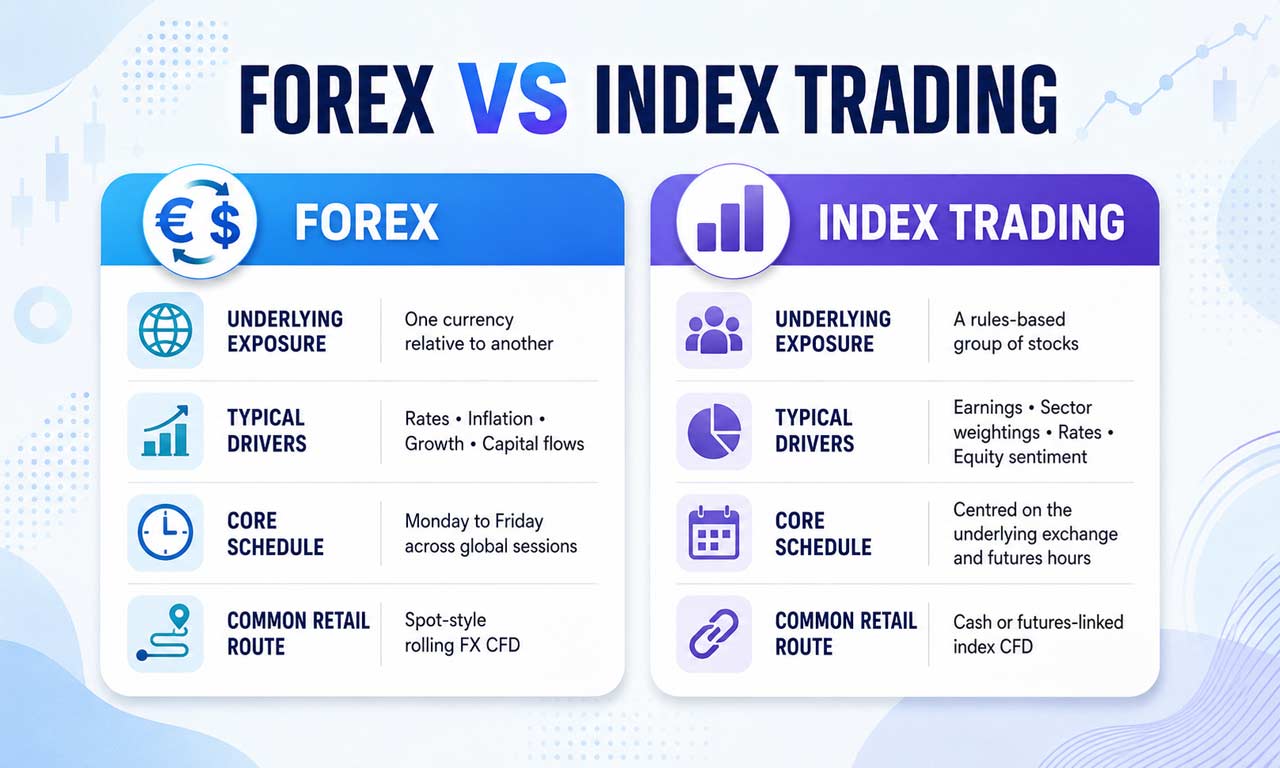
The difference between forex and stock trading comes down to exposure. A currency position compares two economies, while a stock position follows one listed company and may carry ownership rights when shares are purchased directly. Forex and stocks also behave differently around scheduled releases. An index sits between those structures: it reflects multiple companies through one benchmark without giving a CFD trader ownership of the constituent shares.
Equity index weighting changes the exposure
In a capitalisation-weighted equity index, the largest constituents exert more influence than smaller members. Stocks like Apple and Microsoft may shape a technology-heavy benchmark more than dozens of lower-weight companies. An index can rise while many constituent stocks fall if the larger holdings advance strongly enough.
Indices trading focuses on collective equity performance, including earnings, sector rotation and market sentiment. Forex trading focuses on central bank decisions, inflation and trade flows. The two markets may respond to the same headline differently.
Trading hours change the daily rhythm
Forex is traded over the counter across financial centres. As Asia closes, Europe becomes active, followed by North America. This creates 24-hour trading from Monday to Friday, not 24 hours a day through the weekend. There is always a market open during the working week, but activity is uneven. EUR/USD is busier during the European and US overlap than late in the Asian trading session.
An index is tied more closely to the market hours of its underlying shares, even when forex brokers offer an index price for longer. Bursa Malaysia’s securities market has a morning session from 9:00 to 12:30 and an afternoon session from 14:30 to 17:00 local time. Major indices may also trade through a futures market and after-hours trading, but spreads and liquidity can differ from the main market open.
Trading hours shape the trading style. A Malaysian trader available in the evening may find European or US instruments more compatible than local shares. Day trading requires concentrated attention, while swing trading can hold positions across sessions. The 24-hour nature of forex provides flexibility, not guaranteed results. Forex trading takes place with no single trading floor, while stock indices follow exchange calendars. Most forex platforms list major indices alongside currency pairs.
The similarities between forex and index trading
Both markets allow traders to take long or short exposure, use technical analysis and react to scheduled economic news. Retail access commonly involves leveraged derivatives, so position size, financing costs and execution quality matter in each. Forex and index prices can also respond to the same shift in interest-rate expectations or market sentiment, even when the direction and scale differ.
Different trading strategies fit these structures. CFD trading on either market relies on the same core habits: reading charts, respecting margin and knowing exit points before entry.
Key Differences between trading indices vs forex
The differences between trading indices vs. forex become clear when one release reaches both markets. A rate increase can support a currency yet weigh on a stock index as higher financing costs reduce equity valuations. Market conditions and prior expectations still determine the response.
Volatility also arrives in different forms. A single currency pair may jump after an inflation release or policy decision. An index can gap after the underlying stock markets reopen, particularly when earnings or geopolitical news appears outside normal trading hours. After-hours trading can absorb some information, but it does not eliminate opening gaps.
Execution depends on the provider as well as the instrument. Versus Trade offers a trading platform where clients can examine available forex and index contracts, specifications and account conditions.
“I examined the broader trend on higher timeframes and then looked for an entry on lower timeframes, using moving averages for additional context.”
Vitalii Bulynin, Founder and CEO of Versus Trade. Source: Desire To Trade, June 28, 2026,
Forex brokers offer familiar symbols, yet spreads, financing, contract sizes and stop rules vary. Index pricing may follow a cash benchmark, futures contract or adjusted quote.
Ways to trade indices and forex
Forex can be traded through spot transactions, forwards, futures, options and rolling CFDs, though retail availability depends on the broker and jurisdiction. Index exposure may come through futures, options, exchange-traded funds or CFDs linked to a cash or futures price. These routes differ in expiry, ownership, margin, financing and market hours. The instrument therefore changes the trading experience, creating a different trading experience even when the market view is identical.
Trading involves buying and selling contracts, and each route carries a different trading day, settlement rule and cost structure. Trade on the spot, and the pricing follows live quotations. Trade forex through a futures contract, and the value tracks a defined expiry. Before you start trading on any of these routes, compare the specs.
Forex and index trading use different risk maps
Leverage makes relatively small price moves significant in CFD trading. Margin reduces the cash required to open exposure but not the full profit or loss calculation. A stop-loss can define an exit level, although a gapping market may execute beyond the requested price.
Position size connects analysis to risk management. Stop distance, contract value and acceptable account loss belong in the same calculation. Correlation analysis can guide trading decisions. Several positions in major currency pairs can repeat the same dollar exposure, while two index positions may both be dominated by technology or broad risk sentiment.
A solid understanding of market mechanics helps where an index CFD derives its quote from the benchmark or a related futures contract. Leverage, predefined exposure and loss control matter more than the market label. Tools used in forex and stock markets carry over. Position sizing methods used by forex traders translate well to index CFDs.
Pros and cons of trading each market
The pros and cons of trading either market come down to access and concentration. Forex offers broad weekday access and deep liquidity in major currency pairs, but it requires a view on two economies. Index trading condenses a group of companies into one price, though large constituents can create concentration. Leverage, overnight charges and rapid repricing appear in both columns.
Different trading strategies suit different structures. Automated trading can struggle when spreads change. Day trading relies on intraday momentum and execution. Swing trading accepts overnight risk for wider targets. The same discipline discussed in risk management in futures trading carries across to both markets.
Choosing between trading indices and forex
The forex vs index choice often comes down to familiar sources of risk. Using forex in your trading journey means tracking relative monetary policy and economic data. Trading an index means following company earnings, weighting rules and the equity cycle.
Practical constraints matter too. Market hours must fit the trader’s schedule, costs must fit the holding period, and position size must fit the account.
The differences are structural. Forex trading involves buying one currency while selling another. Trading indices and forex differ in exposure, hours and drivers. Both support different trading strategies and can produce rapid losses when leverage meets weak controls.
By Mohd Fazrin, Business Development Director (Malaysia) at Versus Trade